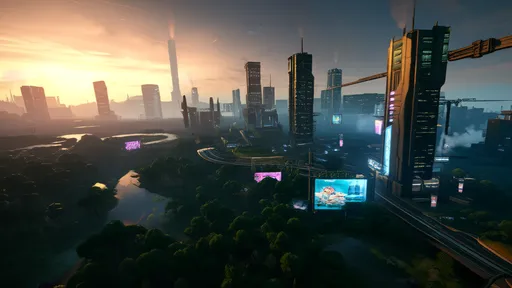
The mobile gaming landscape has undergone a seismic shift with the advent of open-world titles, pushing the very limits of what was once thought possible on handheld devices. These vast, explorable digital realms promise console-like immersion in the palm of your hand, but this ambition comes at a tremendous technical cost. Developers are locked in a constant, high-stakes battle, a delicate dance on a razor's edge between delivering breathtaking visual fidelity and ensuring buttery-smooth performance. This is the central, defining challenge of the modern mobile open world.
At the heart of this struggle lies the fundamental constraint of hardware. Unlike their stationary console and PC counterparts, which draw power from a wall outlet and benefit from robust cooling systems, mobile devices are powered by batteries and must contend with passive cooling and incredibly compact form factors. The thermal envelope is a hard ceiling; push the processor and graphics unit too hard, and the device will throttle performance to avoid overheating, causing frame rates to stutter and plummet. This physical limitation dictates every technical decision, forcing developers to make difficult, creative compromises that are invisible on other platforms.
One of the most significant technical hurdles is rendering these expansive environments. A typical open world is filled with dense forests, sprawling cities, vast oceans, and intricate weather systems, all viewed from potentially any angle and distance. This requires the engine to draw, or render, a massive number of polygons, textures, and lighting effects simultaneously. To manage this, developers employ sophisticated techniques like Level of Detail (LOD) systems, which dynamically swap high-detail models for simpler ones as objects move farther from the camera. The artistry is in making this transition seamless and imperceptible to the player, a task that requires immense tuning and optimization.
Textures present another monumental challenge. High-resolution textures are essential for achieving a visually rich and believable world, but they consume enormous amounts of video memory (VRAM), a precious and limited resource on mobile chipsets. Artists and engineers must often create multiple versions of the same texture—a high-res version for close inspection and progressively lower-res versions for mid and far distances. Advanced texture streaming technology is crucial here, loading only the necessary texture data into memory just before it's needed, a complex ballet of data management that happens in the blink of an eye as the player traverses the world.
Lighting and shadows are perhaps the most computationally expensive elements in any game, and this is doubly true for mobile. Real-time dynamic lighting, where every light source casts accurate, changing shadows, can bring a world to life but can cripple performance. Many mobile open worlds rely heavily on pre-computed "baked" lighting for static objects like buildings and terrain, saving real-time calculations for critical elements like the sun/moon cycle and character-specific lights. The goal is a hybrid approach that creates a convincing illusion of a fully dynamic system without melting the processor.
Beyond the visual spectacle, the world itself must be alive and interactive, which introduces a host of systemic challenges. Non-Player Characters (NPCs) need routines, complex artificial intelligence for combat and interaction, and physics for their movement and clothing. Environmental physics for objects, vegetation that sways and reacts to the player, and realistic water simulation all add layers of processing load. Each interactive element, no matter how small, is a tiny drain on CPU resources, and in an open world, these tiny drains multiply into a flood. Optimizing these systems often means simplifying physics, reducing the number of interactive objects, or using clever tricks to simulate complexity.
Network connectivity adds another layer of complexity for always-online open-world games. Seamlessly synchronizing player position, world state, and multiplayer events with a remote server, all while maintaining a stable frame rate, is a herculean task. Network latency and packet loss can introduce lag and rubber-banding, instantly breaking immersion. Developers must write incredibly efficient netcode that minimizes data transfer and predicts player actions to hide network delays, all while keeping the game world consistent for every player.
The pursuit of balance is therefore not a one-time effort but a continuous process of iteration and refinement that lasts throughout the entire development cycle. It involves teams of engineers writing highly optimized, platform-specific code, artists creating assets that are visually stunning yet efficient, and designers who understand the technical constraints and design gameplay that works within them. Extensive profiling—using tools to identify performance bottlenecks like a specific shader or script—is a daily routine. The final game is a masterpiece of compromise, where every beautiful vista and smooth animation is the result of thousands of deliberate, technical decisions.
Looking forward, the future of mobile open-world games is intrinsically tied to hardware evolution. Each new generation of smartphones and tablets brings more powerful chipsets with dedicated AI cores, hardware-accelerated ray tracing, and more efficient architectures. Cloud gaming also looms on the horizon, promising to offload the heavy computational lifting to remote servers, potentially bypassing device limitations altogether. However, for the foreseeable future, the art of optimization will remain paramount. The greatest achievements in mobile gaming will not be defined by raw power alone, but by the ingenious and creative ways developers harness that power to build worlds that are both beautiful and accessible, proving that the most immersive adventures can indeed fit in your pocket.

By /Aug 26, 2025

By /Aug 26, 2025

By /Aug 26, 2025

By /Aug 26, 2025

By /Aug 26, 2025

By /Aug 26, 2025
By /Aug 26, 2025

By /Aug 26, 2025

By /Aug 26, 2025

By /Aug 26, 2025

By /Aug 26, 2025

By /Aug 26, 2025

By /Aug 26, 2025

By /Aug 26, 2025

By /Aug 26, 2025

By /Aug 26, 2025

By /Aug 26, 2025

By /Aug 26, 2025

By /Aug 26, 2025

By /Aug 26, 2025
